
The Judgment Gap: Why Physician Leadership Requires Thinking at the Right Scope
Physicians are trained to make high-stakes decisions.
They gather information, interpret data, weigh risks, consider consequences, and act under pressure. In clinical work, judgment is not abstract. It affects patients, families, teams, and outcomes.
This is one reason many physicians assume strong clinical judgment should naturally translate into leadership judgment.
Sometimes it does.
But not always.
The judgment that makes someone excellent in one context may not be the same judgment required at a larger scope of leadership. A physician can have excellent judgment at the bedside, in a procedure, in a research project, or within a clinical program, but still struggle when the decision requires team, organizational, or institutional judgment.
This is the judgment gap.
Leadership judgment is not only about making good decisions. It is about making decisions appropriate to the level of responsibility being carried.
Clinical Judgment Is Not the Same as Leadership Judgment
What Is the Difference Between Clinical Judgment and Leadership Judgment?
Clinical judgment often asks: What is the right decision for this patient, this problem, or this immediate situation?
Leadership judgment asks a different question: What is the right decision for the scope of responsibility I am carrying?
That scope may include a team, a division, a service line, an institution, or an ecosystem of stakeholders. As the scope expands, the leader must account for more people, more constraints, more consequences, and a longer time horizon.
This does not make clinical judgment less valuable. Clinical judgment is rigorous, disciplined, and often developed under pressure. But leadership judgment requires an additional layer. It requires the leader to interpret the decision from the level of the system they are responsible for shaping.
A decision can be reasonable at one level and damaging at another.
That is where many leadership mistakes begin.
What Is Leadership Judgment?
Leadership judgment is the ability to interpret a situation, weigh the relevant factors, and make a decision appropriate to the scope of responsibility being carried.
That definition matters because judgment is not applied in a vacuum. Judgment always occurs within a scope.
A physician deciding how to manage a patient is judging at one scope. A program director deciding how to develop fellows is judging at another. A division chief deciding how to allocate faculty effort, build culture, and manage clinical growth is judging at another. A service line leader deciding how to align multiple sites, financial realities, quality metrics, patient access, and institutional priorities is judging at yet another.
The same decision-making process may be involved: gather information, interpret the situation, weigh tradeoffs, and act. But the system being considered is different.
And when the system is different, the judgment must change.

The Lens of Judgment
A camera lens holds the light before the image comes into focus. It represents leadership judgment as the discipline of seeing at the right scope: knowing when to focus on the individual, the team, the organization, or the ecosystem before deciding what the moment requires.
Collection: Maison Collection
Medium: Fine Editorial Still
Volume: Vol. I — Leadership Operating System
Judgment Always Happens Within a Scope
Scope refers to the level of system a person is responsible for or attempting to influence.
At the expert level, the scope may be an individual patient, task, project, or area of technical work. At the team-builder level, the scope expands to people, coordination, development, and shared outcomes. At the executive level, the scope includes multiple teams, resources, priorities, incentives, and organizational consequences. At the institutional-builder level, the scope includes continuity, culture, reputation, succession, external partnerships, and long-term relevance.
This is why a decision that represents sound judgment at one scope may represent poor judgment at another.
For example, “I’ll do it myself” may be good judgment when the goal is to optimize individual performance. If the patient needs something done urgently, or if the task truly requires your expertise, personal execution may be the right decision.
But the same decision may become poor judgment when you are responsible for a team or organization. If the leader always solves the problem personally, the team does not develop capacity. Work does not scale. Others do not learn. Succession becomes weak. The leader becomes the bottleneck.
The action is the same.
The scope is different.
The judgment changes.
The Four Scopes of Leadership Judgment
A useful way to understand leadership judgment is to ask: What level of system is this decision meant to serve?
The same physician may operate across several of these scopes in the same week.
They may see patients as an expert, lead a clinical team as a team builder, chair a committee as an organizational leader, and serve a national society as an institutional builder. The challenge is not that they hold multiple responsibilities. The challenge is knowing which scope each decision belongs to.
Leadership maturity requires the ability to shift judgment based on scope.
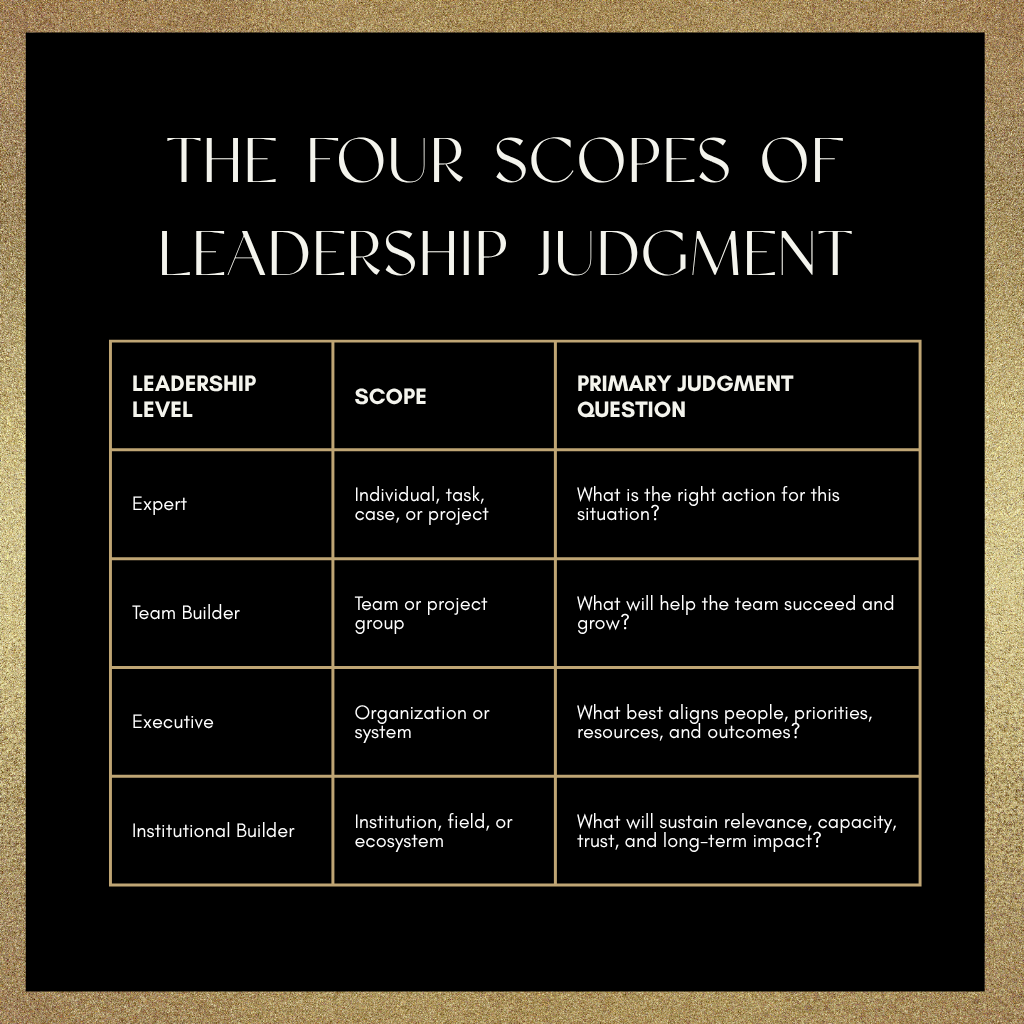
The Four Scopes of Leadership Judgment
A framework table showing how leadership judgment changes by scope. The model compares Expert, Team Builder, Executive, and Institutional Builder levels, highlighting the primary judgment question required at each level of responsibility.
When Good Judgment at One Level Becomes Poor Judgment at Another
Many leadership errors are not caused by a lack of intelligence. They are caused by applying the operating system of one level to the responsibility of another.
An expert may be rewarded for precision, speed, personal excellence, and direct problem-solving. These are valuable qualities. But when that expert becomes responsible for a team, those same instincts may create problems if they remain the default.
A team leader may be rewarded for protecting their people, building cohesion, and advocating for the group. These are important. But when that leader becomes responsible for a larger organization, protecting one team at all costs may create misalignment, duplication, or conflict across the system.
An executive may be rewarded for strengthening organizational performance, improving margin, and aligning resources. But when the responsibility expands to an institutional or ecosystem level, short-term organizational optimization may damage external trust, future partnerships, succession, or long-term relevance.
The problem is not that the old judgment was bad.
The problem is that it was built for a different scope.
Scope Failure: The Cause of Poor Leadership Judgment
Scope failure occurs when the level of judgment does not match the level of the decision.
Sometimes leaders think too small. They solve organizational problems through personal effort. They try to fix a system issue by working harder, being more available, or personally absorbing the complexity.
Other times, leaders think too broadly. They turn a simple individual or team issue into an unnecessary institutional strategy problem. They overcomplicate what should be handled directly.
Sound judgment requires matching the decision to the correct scope.
Before deciding what to do, the leader must first ask: What level of system am I actually responsible for in this decision?
Is this an individual performance issue? A team coordination issue? An organizational alignment issue? A culture issue? A succession issue? An ecosystem issue?
If the scope is misread, even a well-intentioned decision can create the wrong result.
How Scope Failure Shows Up
Scope failure can show up in several predictable ways.
Expert Thinking Applied to Team Problems
This happens when a leader applies individual-level judgment to a team-level responsibility.
The leader may personally fix every problem, answer every question, and rescue every situation. This may produce short-term results, but it prevents the team from developing independence, judgment, and accountability.
The primary failure is not effort. The primary failure is judging from the wrong scope.
The leader is optimizing personal contribution when the responsibility is team capacity.
Team Thinking Applied to Organizational Problems
This happens when a leader protects the interests of their own team without adequately considering the larger organization.
A division, department, or program may want more resources, more autonomy, or more protection from change. From the team’s perspective, that may feel reasonable. But from the organizational perspective, the decision may create duplication, inefficiency, conflict, or inequity across the system.
The leader is optimizing team success when the responsibility is organizational alignment.
Organizational Thinking Applied to Ecosystem Problems
This happens when an organization optimizes for its own short-term interests while damaging the larger ecosystem it depends on.
A health system may maximize short-term revenue but weaken relationships with community physicians, referral partners, payers, regulators, or the public. A professional society may protect existing structures while losing relevance with the next generation. A department may pursue internal prestige while failing to build the partnerships needed for long-term influence.
The leader is optimizing organizational advantage when the responsibility is ecosystem trust and sustainability.
Title Expands, but Judgment Scope Does Not
This is one of the most common leadership mismatches.
A person receives a larger title, but their judgment remains anchored to the scope of their previous role. A newly promoted executive may continue making decisions as if they are responsible only for their former department. A division leader may continue behaving like the senior expert. An institutional leader may continue operating as if they are leading a small working group.
The title has expanded.
The judgment has not.
When that happens, the organization does not receive the level of leadership the role was meant to provide.
The Diagnostic Question for Leadership Judgment
The most useful question is not simply,
“What should I do?”
The better question is:
“At what scope should this decision be judged?”
That question changes everything.
If the decision is being judged at the expert scope, the best answer may be direct action. If the decision is being judged at the team scope, the best answer may be development, delegation, or accountability. If the decision is being judged at the organizational scope, the best answer may require alignment, tradeoffs, resource allocation, or structural change. If the decision is being judged at the institutional scope, the best answer may require long-term positioning, succession, legitimacy, or ecosystem trust.
This is why leadership judgment cannot be separated from scope.
A leader can make a decision that is technically correct and still strategically wrong.
A leader can solve the immediate problem and still weaken the system.
A leader can protect one group and still damage the organization.
A leader can optimize today and still compromise the future.
The quality of judgment depends on whether the decision fits the scope of responsibility.
Key Takeaways for Physician Leadership Judgment
Clinical judgment and leadership judgment are related, but they are not the same. Clinical judgment often focuses on the right decision for a patient, case, or immediate problem. Leadership judgment must consider the level of system the leader is responsible for shaping.
A decision that represents sound judgment at one scope may represent poor judgment at another. “I’ll do it myself” may be appropriate for urgent expert work, but limiting for team or organizational leadership.
Poor leadership judgment often comes from scope failure. Scope failure occurs when the leader applies judgment at the wrong level of the system.
Leadership maturity requires the ability to shift judgment based on scope. The leader must know whether the decision belongs at the level of the individual, team, organization, institution, or ecosystem.
The most important leadership judgment question is: At what scope should this decision be judged?
The Work of Developing Leadership Judgment
Developing leadership judgment is not only about becoming smarter, more experienced, or more confident. It is about learning to see the level of the system more accurately.
For physicians moving into larger leadership roles, this requires a shift in operating system. The leader must move beyond asking only what is clinically correct, technically excellent, or personally efficient. They must also ask what builds capacity, alignment, trust, sustainability, and long-term value at the scope they are responsible for.
This is difficult because the habits that made someone successful at one level often feel responsible, efficient, and even virtuous. Solving the problem yourself feels helpful. Protecting your team feels loyal. Optimizing your organization feels strategic.
But at a larger scope, the question changes.
The real work is learning to judge not only from the level where you have already proven yourself, but from the level of responsibility you are now being asked to carry.
If you are stepping into a larger scope of leadership and want to strengthen your operating system, executive presence, and leadership credibility, I invite you into to begin with a complimentary Leadership Strategy Diagnostic.
Always,
Jia
Jia H. Ng, MD, MSCE, is a physician-scientist and leadership strategist who writes about physician leadership, decision-making, executive presence, and leadership growth.Return to the Maison Library and explore more letters on reputation, leadership, and legacy.
