
The Leadership Mismatch: Why Being a Respected Physician Is Not Enough to Get the Leadership Role You Want
Many physicians spend years building a strong professional reputation.
On the surface, they seem to have many of the qualities associated with leadership. They are respected by colleagues, trusted by patients, clinically strong, knowledgeable, reliable, and often sought out for their judgment. They have built a name for themselves through years of performance.
Over time, they may assume that this record should naturally lead to the leadership role they want.
Respect matters. Experience matters. Excellence matters. Reputation matters.
But they are not always enough.
Respect Is Not the Same as Leadership Readiness
One of the biggest misconceptions in physician leadership is that leadership growth is linear.
The assumption is: become excellent, gain experience, build a reputation, earn respect, and eventually move into a larger leadership role.
But leadership does not work that neatly.
Each level of leadership has different requirements. The skills, behaviors, and reputation that make someone successful and respected in one role may not be the same ones required to lead a team, align a division, shape a service line, or steward an institution.
This is why some respected physicians are surprised when they do not get the leadership role they want. They may have proven themselves at one level, but the role they want requires something different.

The Leadership Gap
A canyon opens between two stone cliffs, its still water reflecting the space between current recognition and larger responsibility. It represents the gap between where a respected physician is known today and the level of operating system, scope, and leadership credibility required for the role they want.
Collection: Maison Collection
Medium: Fine Editorial Still
Volume: Vol. III — Leadership & Visibility
Leadership Requires a Different Operating System
The issue is not that respected physicians lack talent. The issue is that larger leadership roles require a different way of functioning.
At each level, the leader needs a different operating system. An operating system is the way a leader thinks, decides, communicates, behaves, regulates themselves, and creates value at a particular scope of responsibility.
This includes visible skills, but it also includes less visible capacities:
Judgment
Mental models
Emotional regulation
Nervous-system calibration
The ability to create value at a larger scope
The judgment required to manage your own clinical work is not the same as the judgment required to lead a team. The mental models needed to run a project are not the same as the mental models needed to shape a division. The emotional regulation required to handle a difficult patient conversation is not the same as the regulation required to make unpopular decisions, manage political tension, hold competing priorities, or stay steady when the system is under pressure.
As the scope of leadership expands, the leader must be able to tolerate more ambiguity, more conflict, more visibility, more competing demands, and more delayed gratification. This is why a physician can be brilliant, respected, and deeply capable in one context, but still feel unprepared or unseen for a larger leadership role.
They are not just missing a skill. They may be operating from a system designed for a different level of scope.
The Three Requirements of Leadership Growth
Leadership growth depends on three things: scope, operating system, and leadership credibility.
Scope is the level of responsibility, influence, or system the leader is being asked to carry. Is it at the level of the individual person, task, or project? Is it at the level of a team? Is it across multiple teams and systems? Or is it at the level of an institution, field, or ecosystem?
Operating system is how the leader thinks, decides, communicates, behaves, regulates themselves, and creates value at that scope.
Leadership credibility is whether others perceive and trust the leader as able to carry that level of responsibility.
A physician may be highly respected as an expert, but the leadership role they want may require a different scope of thinking, decision-making, communication, influence, execution, and self-regulation.
What made them respected in one context may not be sufficient for the leadership role they now want.
The Problem Is Leadership Mismatch
The problem is that leadership mismatches are common. A mismatch occurs when the level of responsibility, the leader’s operating system, and the leader’s credibility are not aligned.
There are several ways this can happen:
A physician may have the experience, skill, and reputation that made them successful at one level, but not yet have the operating system required for the level they want to enter.
A physician may already be capable of operating at a larger scope, but not yet be perceived as credible at that level.
A physician may receive the title and authority of a higher-level role, but continue to think and operate from a lower-level pattern.
Each mismatch creates a different problem.
The capable but under-recognized leader may not get the opportunity. The credible but underprepared leader may get the role but struggle to deliver the results the role requires. The titled leader who continues to operate below the level of the role may create confusion, bottlenecks, weak decisions, disengagement, or organizational drift.
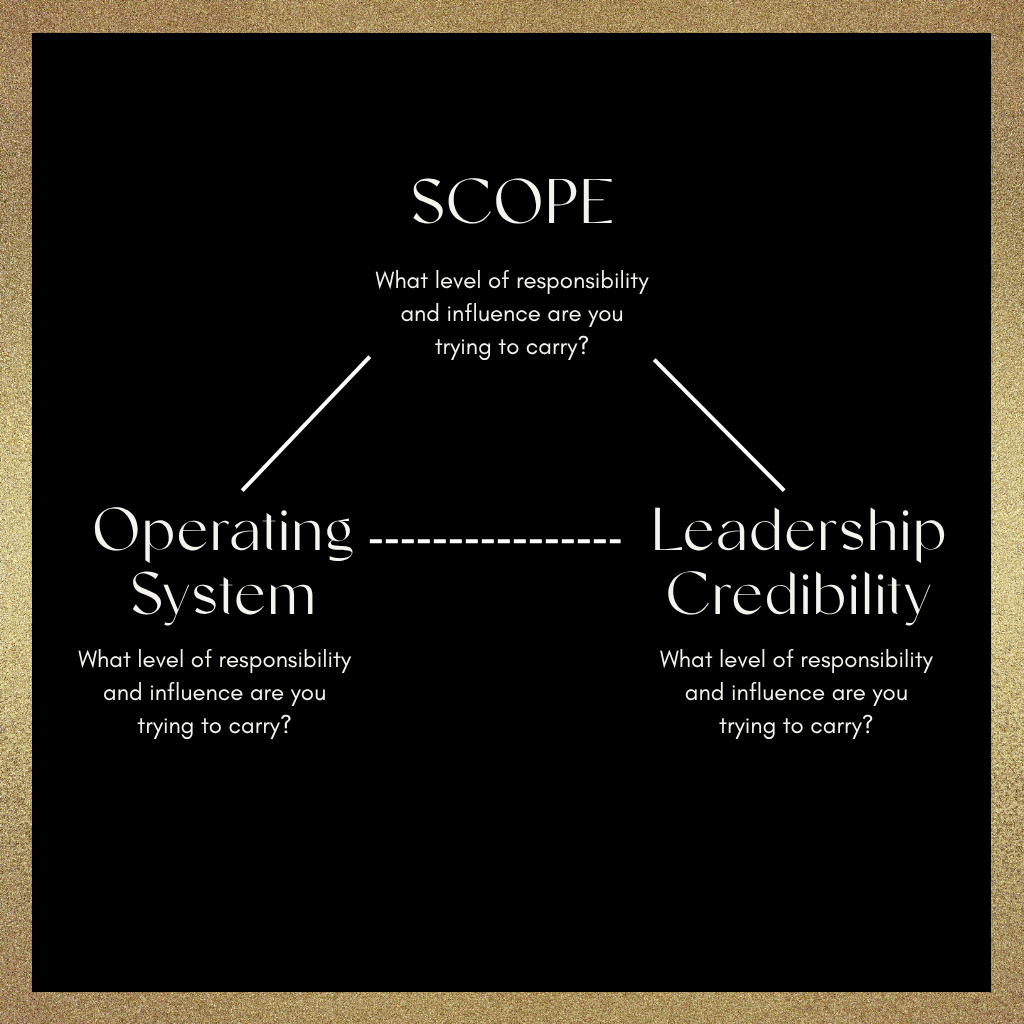
Leadership readiness requires alignment between the scope of responsibility, the operating system required for that scope, and the leadership credibility others assign to the physician.
Why Competency Frameworks Still Need a Leadership Level
Many leadership assessments focus on important competencies.
They may evaluate leadership skills, communication, emotional intelligence, professionalism, business skills, and knowledge of the healthcare environment. These domains matter. Physicians who want larger leadership roles do need to develop skills in communication, relationship management, strategy, finance, governance, quality, patient safety, organizational culture, and change management.
The more important question is not only, “What competencies does this physician need?”
The better question is:
“What level of leadership is this physician trying to operate in?”
That matters because the same competency changes depending on the scope of responsibility.
That matters because the same competency changes depending on the scope of responsibility. Communication at the level of a patient encounter is not the same as communication across a division. Strategic thinking for a project is not the same as strategic thinking for a service line. Influence within a team is not the same as influence across an institution.
Even qualities that sound universally positive can change depending on the level. Independence may be valuable for an expert who needs to make strong individual decisions. But at a larger leadership scope, too much independence can become isolation or failure to build alignment. Empathy may help a physician build trust with patients and colleagues. But in a larger leadership role, empathy must be paired with judgment, boundaries, prioritization, and the ability to make difficult tradeoffs.
This is why leadership development cannot stop at a checklist of competencies, even a good one.
The more important question is not only, “What competencies does this physician need?”
The better question is: “What level of leadership are they trying to operate in, and what does that level require?”
Without that question, leadership development can become fragmented. It may identify important skills, but it may not help the physician build the operating system or leadership credibility required for the specific role they want.
Why Respected Physicians Still Do Not Get the Leadership Role They Want
Many respected physicians do not miss leadership opportunities because they lack ambition, intelligence, experience, or clinical credibility.
They miss them because they are still being recognized for the level where they have already proven themselves, rather than being trusted for the level they want to enter.
They may be seen as excellent clinicians, researchers, educators, or program builders. But the leadership role they want may require others to see them differently.
They may need to be trusted as someone who can lead people, align priorities, manage complexity, make tradeoffs, influence stakeholders, and create results through others.
That is a different form of credibility.
The Operating-System Gap
The first gap is the operating-system gap.
This is the gap between how a physician currently functions and how the desired leadership role requires them to function.
For example, a physician may be an excellent problem-solver. At the expert level, that is an asset. But in a larger leadership role, the goal is not always to personally solve the problem. The goal may be to build the system, team, or process that prevents the same problem from recurring.
A physician may be a reliable executor. But a larger leadership role may require setting direction, making strategic tradeoffs, delegating effectively, and creating alignment across people who do not all report directly to them. A physician may be trusted clinically. But the role may require organizational judgment, political awareness, financial understanding, and the ability to communicate across multiple stakeholders.
The operating-system gap is not only about skill. It is about how the physician interprets the situation. For example:
Do they see a people problem when it is actually a system problem?
Do they see a communication issue when it is actually a conflict in priority?
Do they try to solve through personal effort when the real work is to build capacity through people, structures, and alignment?
Do they react to tension as a threat, or can they stay regulated enough to make a clear decision under pressure?
These are not generic competencies. They are level-specific leadership capacities.
The issue is not that their previous strengths are bad. The issue is that those strengths may not be enough for the scope of leadership they want.
The Leadership-Credibility Gap
The second gap is the leadership-credibility gap.
This is the gap between what a physician may be capable of doing and what others trust them to do.
A physician may be ready for more, but if others still perceive them primarily as an excellent clinician, researcher, educator, or executor, they may not be considered for broader leadership opportunities. This is not only about self-promotion. It is about evidence, visibility, and witness.
The leadership-credibility gap raises a different set of questions:
Do others see how this physician makes decisions?
Do they see how this physician thinks beyond their own work?
Do they see how this physician leads people, aligns priorities, handles conflict, manages complexity, and creates results beyond personal effort?
Do they see the physician stay steady when the stakes are higher, the room is more political, and the answer is less obvious?
But there is another question that matters just as much: Who gets to see it?
A physician may already be operating with broader judgment, but only in rooms where the decision-makers are not present. They may be solving system-level problems, but their work is only visible to their immediate team. They may be leading with executive-level maturity, but their reputation remains trapped inside a local room, committee, division, or project.
Leadership credibility does not grow only from doing the work. It grows when the right people witness enough evidence to trust the leader at a larger scope.
This is where the strategic reputation architecture matters.
Strategic reputation architecture is how you make your leadership capacity legible to the people who need to trust you at the next scope. It is the intentional design of the evidence, rooms, relationships, and narratives that allow others to understand the level at which you are capable of operating.
The right people need to see how the physician thinks, decides, communicates, aligns others, handles tension, and creates value beyond personal effort. Sometimes the work is strong, but the room is too small. Sometimes the physician is operating at a higher level, but their reputation has not traveled beyond the people who already know them.
Leadership credibility is built when the right people can recognize the leader’s ability to operate at the scope the role requires.
What Worked Before May Not Be Enough Now
What made someone successful at one level may not be enough at another.
In some cases, the very strengths that created success can become limitations if they remain the leader’s default operating system.
The physician who is always willing to solve the problem may become the bottleneck. The physician who is known for being highly reliable may become overused for execution but not considered for strategy. The physician who is respected as the expert may not automatically be seen as someone who can lead a team, shape a system, or make enterprise-level decisions.
The physician who is calm and decisive in clinical uncertainty may still need a different kind of steadiness when navigating organizational ambiguity, competing incentives, and stakeholder conflict.
This is why leadership growth requires more than accumulating experience. It requires alignment between the scope of responsibility, the operating system required for that scope, and the leadership credibility others assign to the physician.
Key Takeaways for Physician Leadership Readiness
Being respected as a physician is valuable, but it is not the same as being trusted for a larger leadership role.
Physician leadership growth requires alignment between three things: the scope of responsibility, the operating system required for that scope, and the leadership credibility others assign to the physician.
Competencies matter, but they are incomplete without context. The same skill or quality can function differently depending on the level of leadership a physician is trying to operate in.
Many respected physicians do not miss leadership opportunities because they lack experience or intelligence. They miss them because they are still recognized for the level where they have already proven themselves, rather than the level they want to enter.
Strategic reputation architecture matters because leadership credibility is built when the right people can see, understand, and trust the physician’s capacity to operate at a larger scope.
The Real Work of Physician Leadership Growth
To grow into larger leadership roles, physicians must intentionally build the operating system required for the scope of leadership they want. They also need to become credible in the eyes of the people who decide whether to trust them with that responsibility.
That means developing how they think, decide, communicate, delegate, influence, regulate themselves, and create value at a broader level. It also means making that growth visible through the right work, the right conversations, the right rooms, and the right evidence.
Leadership growth requires alignment between the responsibility you want to carry, the operating system you have built, and the leadership credibility others assign to you.
If you are being asked to carry a larger scope of leadership and want to strengthen the way you think, communicate, and create credibility at that level, I invite you to begin with a complimentary Leadership Strategy Diagnostic.
Always,
Jia
Jia H. Ng, MD, MSCE, is a physician-scientist and leadership strategist who writes about physician leadership, decision-making, executive presence, and leadership growth.Return to the Maison Library and explore more letters on reputation, leadership, and legacy.
