
You Got the Leadership Role. Now Prepare to Lead Differently
You got the physician leadership role.
At first, there may be excitement, pride, and relief. The opportunity finally came. Someone saw your work, trusted your judgment, and believed you were ready to carry more responsibility. But after the initial excitement, the weight of the role becomes real.
You do not want to simply hold the title. You want to lead well.
So how do you prepare for a new physician leadership role?
You prepare by recognizing that getting the role is not the same as being prepared for the work of the role.
You want to be worthy of the trust that has been placed in you. You want to make good decisions, support the people around you, avoid becoming the bottleneck, and leave the team, program, division, department, organization, or institution stronger than you found it.
That is the right concern to have. Getting the role is not the same as being prepared for the work of the role. A new leadership role does not simply require more time, more meetings, or more responsibility. It requires a different way of operating. You can no longer create value only through personal expertise, responsiveness, and direct execution. In a larger leadership role, you must create value through judgment, strategy, prioritization, alignment, delegation, capacity-building, and decisions that allow others to move in the right direction.
This is the real preparation for leadership. Not just learning the calendar, understanding the org chart, or meeting the key stakeholders. Those things matter, but the deeper work is upgrading the operating system through which you think, decide, communicate, and create value.
The Title Opens the Door. It Does Not Do the Work.
A new title can create authority, visibility, and access. It can put you in new rooms, place you at new tables, and make others look to you for direction. It can create the expectation that you will now lead at a different level.
But the title itself does not change how you think. It does not automatically change your default patterns. It does not automatically teach you how to make decisions with incomplete information, manage competing priorities, delegate real authority, align stakeholders, or build systems that do not depend on your personal effort.
This is why preparation matters. You may have earned the role because you were excellent at the previous level. You were dependable. You followed through. You knew the work. You could solve problems. You could be trusted to get things done. Those strengths are real, but the new role may require a different mechanism of value creation.
This is the beginning of a leadership transition, not simply a change in title.
The question is no longer only, “Can I do this well?”
The question becomes, “Can I create the conditions that allow other people, structures, and systems to do this well?”
That is a different kind of leadership.

Before the Role Begins
An old wooden door holds the moment before a new role begins. It represents the pause between receiving a leadership title and preparing to lead differently: to think with greater clarity, make stronger decisions, and create value beyond personal effort.
Collection: Maison Collection
Medium: Fine Editorial Still
Volume: Vol. I — Leadership Operating System
The Real Preparation Is an Operating-System Upgrade
Many new physician leaders prepare for a role by focusing on logistics. They ask about meetings, reporting structures, key projects, immediate problems, and expectations from above. These are important questions, but they are not enough.
The deeper preparation is internal. You need to ask how you must think differently in this role, how you will make decisions differently, what should no longer depend on your personal effort, how you will create alignment instead of simply communicating updates, what tradeoffs you will need to make, and what kind of value you are now responsible for creating.
These are operating-system questions.
A leadership operating system is the internal way you interpret responsibility, make decisions, set priorities, manage complexity, communicate direction, and create value through others. It is not one skill. It is the system underneath the skills.
Communication, delegation, emotional intelligence, conflict management, financial literacy, and strategic thinking all matter. But they do not operate in isolation. They are filtered through your leadership operating system. Two physician leaders can receive the same advice about delegation and use it very differently. One may delegate in a way that creates ownership, clarity, and capacity. Another may delegate tasks while still centralizing decisions, correcting every detail, and remaining the hidden bottleneck.
The difference is not just information. The difference is how the leader thinks. That is the operating system.
Preparing for a new physician leadership role means designing your leadership operating system before the demands of the role design it for you.
Why the Old Operating System May Not Be Enough
The operating system that helped you earn the role is often built around excellence at a smaller scale. It may include personal responsibility, responsiveness, expertise, precision, persistence, and follow-through. These are real strengths. They may be exactly why you were chosen.
But in a larger physician leadership role, those same strengths must be upgraded. Responsiveness must become prioritization. Ownership must become capacity-building. Expertise must become judgment. Communication must become alignment. Reliability must become system design. Execution must become strategy.
The issue is not that the old operating system was wrong. It may have been highly effective for the previous role. The problem is that the new role creates value through a different mechanism. In one role, being the person who does the work may be the highest-value contribution. In another role, being the person who personally does the work can limit the system.
This is one of the hardest transitions for high-performing physicians. You are used to being trusted because you can carry responsibility yourself. But larger leadership requires you to build the people, structures, decisions, and alignment that allow responsibility to be carried by the system.
How Value Creation Changes in Leadership
You prepare better when you understand how value creation changes as responsibility expands.
Across different leadership levels, physician leaders create value through different mechanisms: personal excellence, people, systems, alignment, and ecosystem influence.
Expert: Value Through Personal Excellence
At the expert level, value is created primarily through personal expertise and execution. You know the work, perform the work, solve problems directly, and produce results through your own skill, effort, and judgment. Excellence depends heavily on what you personally know, decide, and do.
Team Builder: Value Through Others
At the team-builder level, value is created through others. You must coordinate people, clarify roles, delegate effectively, develop talent, manage conflict, and build enough trust and structure for the team to perform beyond your personal effort. The work is no longer only about your individual output. It is about whether the people around you can move well together.
Executive: Value Through Systems and Alignment
At the executive level, value is created through systems, priorities, and alignment. You must decide what matters most, allocate resources, manage tradeoffs, align stakeholders, simplify complexity, and build structures that allow multiple teams to move in the same direction. Your value comes less from personal responsiveness and more from judgment, prioritization, and the ability to make the larger system work.
Institutional Builder: Value Through Ecosystem Influence and Long-Term Direction
At the institutional-builder level, value is created through long-term direction, governance, culture, succession, external trust, and ecosystem influence. You must think beyond immediate operations and consider how decisions shape the institution, the field, partnerships, external relationships, and the future leadership pipeline. The work is no longer only about making the internal system function. It is about positioning the institution to remain trusted, relevant, and adaptive within the larger ecosystem it serves.
This is why the new role requires more than more effort. It requires a different operating system. You must move from doing the work to designing how the work creates value.
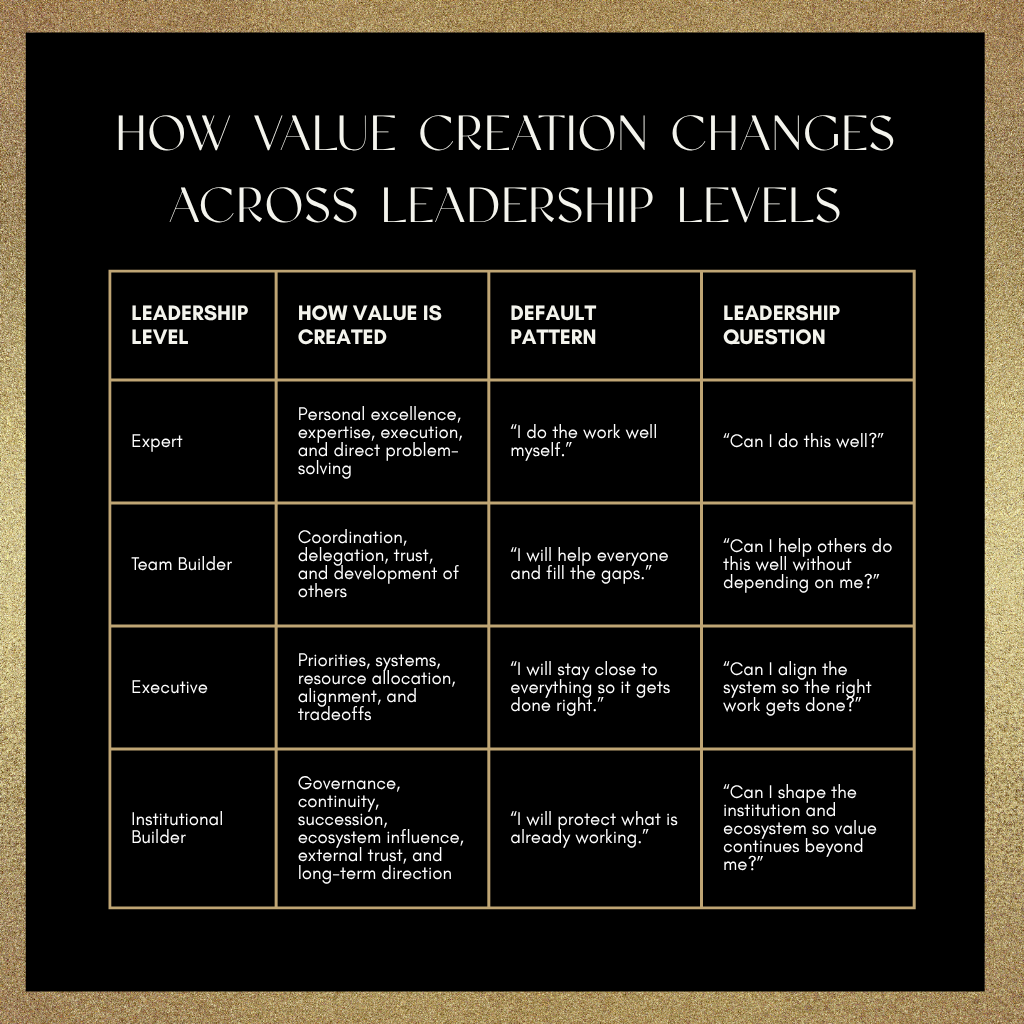
As leadership responsibility expands, value is created through different mechanisms. The leader moves from personal execution to coordination through others, systems alignment, and ecosystem-level influence.
Before the role officially begins, there is a valuable window when you can prepare without being fully consumed by the demands of the position. Once the role starts, the calendar fills quickly. Meetings accumulate. Urgent issues appear. People bring expectations, requests, problems, and assumptions. If you have not already decided how you want to operate, the role will begin shaping your operating system for you.
That is why preparation should go beyond logistics. The goal is not only to learn the role. The goal is to design how you will carry it.
Six Ways to Prepare Before You Step Into the Role
Before you step into a new physician leadership role, preparation should include more than orientation. You need to understand the role beneath the title, clarify how value will be created, and identify the decisions, relationships, and operating patterns that will shape your success.
Understand What You Are Really Being Asked to Carry
A leadership title rarely tells the whole story. The formal description may say what the role oversees, but it may not reveal what the role is really being asked to repair, build, protect, or change.
Before you step in, ask yourself: What is the real work beneath this role? Are you being asked to stabilize a team, grow a program, repair trust, improve operations, build infrastructure, increase visibility, develop people, create revenue, represent the organization externally, or make difficult decisions that others have avoided?
Each answer requires a different operating pattern. If the real work is stabilization, you need consistency, clarity, and trust. If the real work is growth, you need focus, investment, and talent. If the real work is repair, you need to understand history, credibility, and relationships. If the real work is transformation, you need sequencing, communication, and the ability to manage resistance.
Do not only ask, “What is my role?” Ask, “What am I really being asked to carry?”
Define How You Will Create Value Differently
Many physicians enter leadership roles assuming their value will continue to come from being helpful, available, knowledgeable, and hardworking. Those qualities still matter, but they may no longer be the highest-value contribution.
In the new role, your value may come from making better decisions, clarifying what matters most, stopping low-value work, developing people who can lead without you, aligning stakeholders who have been moving in different directions, or protecting the long-term health of the system when short-term demands are loud.
This is a major shift. Your value is no longer measured only by what you personally complete. It is measured by what becomes possible because of how you think, decide, align, and build.
Before the role begins, define the new mechanism of value creation. Ask:
What will I create through my judgment?
What will I create through others?
What will I create through systems, relationships, and strategic decisions?
Identify What Must Stop Depending on You
One of the most important preparation questions for a new leader is: What must stop depending on me?
This question can be uncomfortable because many high-performing physicians have built trust by being dependable. You may be the person who responds, fixes, remembers, follows through, and rescues the work when others drop it. That reliability may have helped you earn the leadership role, but in the next role, the same pattern can become a limitation.
If every decision depends on you, the system slows down. If every detail requires your review, others do not develop judgment. If every conflict returns to you, the team does not learn how to resolve tension. If every project depends on your personal effort, the organization does not build capacity.
So preparation requires identifying what should no longer depend on you personally:
What decisions should others be able to make?
What standards should be clear enough that people can act without waiting?
What processes should be built so that work does not require constant rescue?
What relationships need to be strengthened so you are not the only bridge?
What leadership capacity needs to be developed in others?
This is not abdication. It is leadership design.
Clarify the Decisions That Will Define the Role
Every leadership role has defining decisions. Some are obvious. Others are less visible but just as important. You may need to decide what the top priorities will be, which projects should continue, which projects should pause, how resources will be allocated, who needs to be developed, what behaviors will be tolerated, what standards will be enforced, and what tradeoffs must be made.
These decisions matter because they set the pattern for the role. If you avoid them, the role will still be shaped — but by inertia, politics, urgency, and other people’s expectations.
Preparation requires identifying the decisions that cannot be left vague:
What must be clarified early?
What is currently ambiguous?
What will people look to you to decide?
What decision, if delayed, will create confusion?
What decision, if made poorly, will weaken trust?
What decision will signal your priorities?
This is where judgment becomes central. At larger levels of leadership, the work is less about having all the answers and more about knowing which decisions matter most, when they need to be made, who needs to be involved, and what factors should carry the most weight.
Learn the Strategic Terrain
Physician leaders are often told they need to be more strategic, but “strategic” is often left undefined. In practice, strategy is not about sounding visionary or using more abstract language. Strategy is the disciplined choice of where to focus, what to prioritize, what to stop doing, what path to take, and how to align people and resources toward the desired outcome.
A new leadership role requires strategy because you cannot do everything. You cannot solve every problem at once, satisfy every stakeholder equally, preserve every legacy activity while also building the future, or create capacity if every priority remains a priority.
Before you step in, learn the terrain.
What has already been tried?
What keeps failing?
Where is energy being spent without enough value?
What are the real constraints?
What are the political sensitivities?
What are the financial realities?
What are the hidden dependencies?
What matters most in the first six to twelve months?
These are strategic questions. They force you to move beyond activity and into direction.
Build Relationships Before You Need Them
Leadership does not happen only through decisions. It happens through relationships, trust, influence, and alignment. When preparing for a new role, you should identify the relationships that will matter before there is a crisis.
You need to understand who has historical knowledge, who carries informal influence, who may be skeptical, who will be affected by early decisions, who needs to be heard before change is announced, who could become an ally or truth-teller, who will be responsible for implementation, and who needs to feel ownership instead of simply receiving instructions.
This is not politics in the shallow sense. It is leadership due diligence.
A leader who waits until a difficult decision to build relationships is already late. The preparation period is the time to understand the terrain, listen for patterns, learn what has been tried before, identify hidden constraints, and build enough trust that future decisions can land.
The Preparation Most Leaders Do Not Get
Most new leaders receive some form of orientation. They may be introduced to the calendar, the reporting structure, the budget, the major initiatives, the key stakeholders, and the immediate problems waiting for them.
That kind of preparation is useful. But it is not the same as preparing to lead differently.
The missing preparation is often operating-system preparation: the work of clarifying how you will think, decide, prioritize, communicate, and create value in the new role.
Before the role begins, you need space to examine the patterns that made you successful before and decide which ones need to evolve. You need to know where your personal execution may become a bottleneck, where your responsiveness may need to become prioritization, where your expertise may need to become judgment, and where your communication may need to become alignment.
This preparation is rarely built into the transition. Most leaders are expected to learn it while already carrying the role. But by then, the pressure of the role often pulls them back into familiar habits.
That is why the preparation before the role begins matters so much. It is the rare window when you can design how you will operate before urgency, inherited problems, and other people’s expectations begin designing it for you.
The goal is not simply to become more confident, more polished, or more communicative. Those qualities may support the transition, but they are not the transition itself. The deeper work is becoming able to carry the role: to think at the right level, make sound decisions, create alignment, and build capacity beyond your own effort. That is the operating-system upgrade.
Key Takeaways for Physician Leaders
Getting the leadership role is not the same as being prepared for the work of the role. A new leadership title requires more than logistics, meetings, and responsibilities. It requires an operating-system upgrade: a different way of thinking, deciding, prioritizing, communicating, and creating value.
As leadership responsibility expands, value is created through different mechanisms.
At the expert level, value comes primarily through personal excellence, expertise, and execution.
At the team-builder level, value comes through coordination, delegation, trust, and the development of others.
At the executive level, value comes through systems, priorities, resource allocation, and alignment.
At the institutional-builder level, value comes through governance, continuity, ecosystem influence, external trust, and long-term direction.
The operating system that made you successful in a previous role may not be enough for the next one. Personal expertise, responsiveness, and execution often need to evolve into judgment, strategy, alignment, delegation, and capacity-building.
The best preparation includes more than learning the role. You should clarify what you are really being asked to carry, define how you will create value differently, identify what must stop depending on you, understand the defining decisions of the role, learn the strategic terrain, and build relationships before they are needed.
The goal is not to abandon the strengths that helped you earn the role. The goal is to upgrade the operating system those strengths now run through, so you can carry a larger responsibility without becoming the bottleneck.
For physician leaders, this is the upgrade that matters. The role may begin with a title, but the real leadership begins when the operating system changes.
If you are preparing to step into a larger leadership role and want to strengthen your operating system, executive presence, and leadership credibility, I invite you to begin with a complimentary Leadership Strategy Diagnostic.
Always,
Jia
Jia H. Ng, MD, MSCE, is a physician-scientist and leadership strategist who writes about physician leadership, decision-making, executive presence, and leadership growth.Return to the Maison Library and explore more letters on reputation, leadership, and legacy.
